LESSONS & PRICING

We won’t work through a fixed syllabus. We’ll work on what’s holding you back right now.

Lessons don’t run from “Lesson 1” straight through to “Lesson 50.”

I will examine:

What can you do now?

What do you want to be able to do?

Then we find a path between them.

Book a Free 30-Minute Online Consultation

PERSONALISED 1:1 LESSONS

01

1:1

Individual lessons

02

4 lessons

Recommended starting block

03

60 minutes

Each lesson

Start with the problem you’re facing now, rather than a preset chapter.

LESSON STRUCTURE

How do lessons actually work?

Step 01

Observe

Identify the problem

“I am too slow at changing chords,” “my solos have no soul,” and “I can’t hear the chord” describe symptoms. First, I listen and watch how you approach the task. What’s holding you back may be different from what you thought.

Step 02

Break it down

Narrow it down to something you can work on right now

“I want freedom in my solos” is a long-term goal. But “practise moving along a string” is something you can actually work on.

Step 03

Adjust

Change the exercise in response to what you do

During an exercise, I might:
• Add or remove notes to deal with.
• Change part of the rhythm.
• Require you to move back and forth between positions.
• Ask you to develop variations from a phrase.
• Change the volume balance between the song and the bass line I’ve layered over it.

This helps us find the conditions under which you can begin to do it. Then we gradually raise the difficulty.

Step 04

Connect

Put what you’ve practised back into music

How can you use what you’ve practised in real playing? I’ll ask you to connect it with other knowledge and techniques you already know, so you can expand the range of things you’re able to do. In the longer term, the goal is to gradually develop your own way of solving musical problems.

A student’s voice

“In class, Newton had me start jamming with just three notes. I focused on repetition and building phrases, then added other elements… I could feel it developing layer by layer.”

CONCRETE CASES

Where do we start?

Find the question closest to your current bottleneck. I will break big, abstract goals into tangible exercises you can work through step by step.

Case 01 / Chord structure, listening, and theory

“I want to learn how to choose chords for a song.”

The first step in harmonizing is learning to recognize the harmony you already hear in your head. That's why we begin with transcription. Starting with a bass note you've found, I'll guide you to:

• Infer: “What chord might this be?”

• Analyse: “If it's this chord, I should hear this note.”

• Verify: “Listen to this line on the piano.”

• Conclude: “So this is the chord.”

The next step is changing a chord choice. We might ask: Why did the original use this chord? What did another song use instead? How can we simplify or strengthen it? That lets ear training and theory reinforce each other.
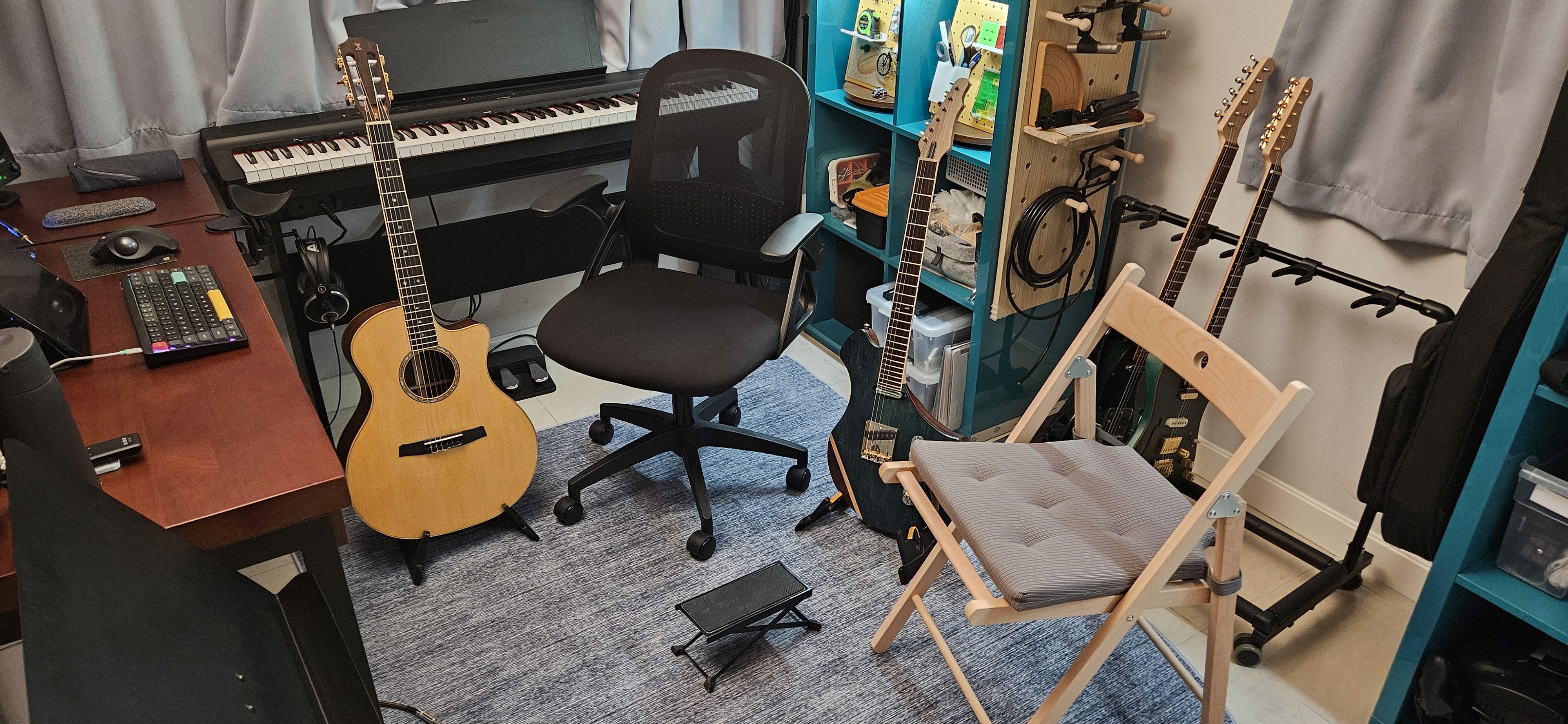
STUDENT LEARNING EXPERIENCES

Student learning experiences

Student V | Improvised solos

“What I improvised was like… every word was right, but put together they made no sense.”

Student V | Improvised solos

I’d played guitar for years, watched videos on techniques and theory online, and studied with other teachers. I’d also learned and practised pentatonic shapes, patterns, and chord tones.

But when it came to actual improvisation, everything I played seemed “correct” on its own, yet together it didn’t make sense.

In lessons, Newton broke down what we called “improvisation”. We started with a few notes and worked on repetition, rhythm, pauses, and phrase development. Only then did we gradually add other sounds and techniques. It felt like progressing layer through layer:

First, I got the core stuff working. Only then did we add embellishments and lengthen the phrase before or after. Step by step, I could hear an idea grow into a phrase.

Student N | Acoustic songwriting and arranging

“The song had already been recorded and was being mixed. But mixing wasn’t the problem…”

Student N | Acoustic songwriting and arranging

Before I came to Newton, I’d already recorded my song and started mixing it. But the two guitars kept clashing, and the dynamics and sense of sections weren’t clear enough.

Newton suggested:
1. Tab out the whole song.
2. Reduce the opening of the verse to a simple C chord held for one bar.

I was used to making arrangements fuller and richer, so I was really resistant at first.

But after sticking with it for a few lessons, I found that writing the music down this way felt like looking at myself in a mirror for the first time.

After taking so much away, I could hear what each element was actually doing. Things I’d chosen by instinct became material I could revisit, analyse, and edit.

After the rearrangement, listening back to my original arrangement, I could only say: “We had a good time. Goodbye, my love.”

What’s holding you back? Let’s look into your situation with a free 30-minute consultation.

Book a Free 30-Minute Online Consultation

STARTER UNIT / 4 LESSONS

New students start with 4 lessons

Start with a short-term goal

Some abilities take months or longer to develop. Other problems can show progress much sooner.

I recommend that new students start with 4 lessons focused on one short-term goal. That gives you a clear way to see whether my teaching suits you.

After 4 lessons, you are welcome to continue with regular lessons if my teaching suits you. If it doesn’t, you can stop without pressure—and you’ll at least understand your problems and needs more clearly.

TEACHER’S PERSPECTIVE

This lets me:

• Understand where you are now: Listen to and watch how you actually play to find what’s holding you back.

• Design exercises that suit you: Narrow a big, abstract goal to a concrete step you can work on now.

• Adapt to your needs: Adjust the difficulty and focus of practice based on what your playing reveals.

STUDENT’S PERSPECTIVE

This lets you:

• Work on a real problem: Make tangible progress on one real bottleneck over 4 lessons.

• Experience my teaching and thinking: Learn about how I would break down problems.

• See whether it suits you: Decide freely whether to continue, with no commitment to a longer package.

PRICING

Pricing

Clear terms. The price is the same for in-person and online lessons. For regular lessons, I recommend weekly lessons to maintain momentum.

RECOMMENDED

Regular lessons

Individual lessons

HK$1,650

4 lessons × 60 minutes

You can choose to take lessons in person or online.
In person: About a 3-minute walk from Prince Edward Station Exit C (near Pioneer Centre).
Online: via Zoom

Recommended frequency: Once a week

Weekly lessons are recommended, in order to maintain momentum and continuity, and avoid wasting time figuring out where we left off.

Book a Free 30-Minute Online Consultation

FLEXIBLE

What if I can only come every other week or occasionally?

Lessons every other week or on an irregular schedule

HK$500

60 minutes

I can arrange them, but I don’t recommend treating lessons every other week as the first choice.

Students tend to think, “If I have two weeks between lessons, I can prepare more thoroughly,” and assume that’s better value. More often, what actually happens is:

• Practice gets postponed until the day before the lesson.
• The focus of the exercise gets forgotten, so the thing that really needs work doesn’t get practised.
• A good part of the lesson is spent picking up where we left off.

For that reason, lessons every other week or on an irregular schedule are charged at the low-frequency rate: HK$500 for 60 minutes.

But if work or life makes weekly lessons genuinely impractical, this is still an option.

Arrange Flexible Lessons on WhatsApp

ARRANGEMENTS

Lesson arrangements

Validity

Please complete 4 lessons within five weeks.

Rescheduling

Please give at least 48 hours’ notice if you need to reschedule.

Indiefret guitar lesson studio

CONSULTATION

“But I’m not sure what I need to learn”

That’s exactly why the free consultation exists. You don’t need to be able to diagnose yourself first. Tell me where you are and where you’d like to go, and I’ll help you find a path between them and guide you through it.

30 minutes on Zoom

A focused one-to-one assessment

No hard sell or follow-up pressure